
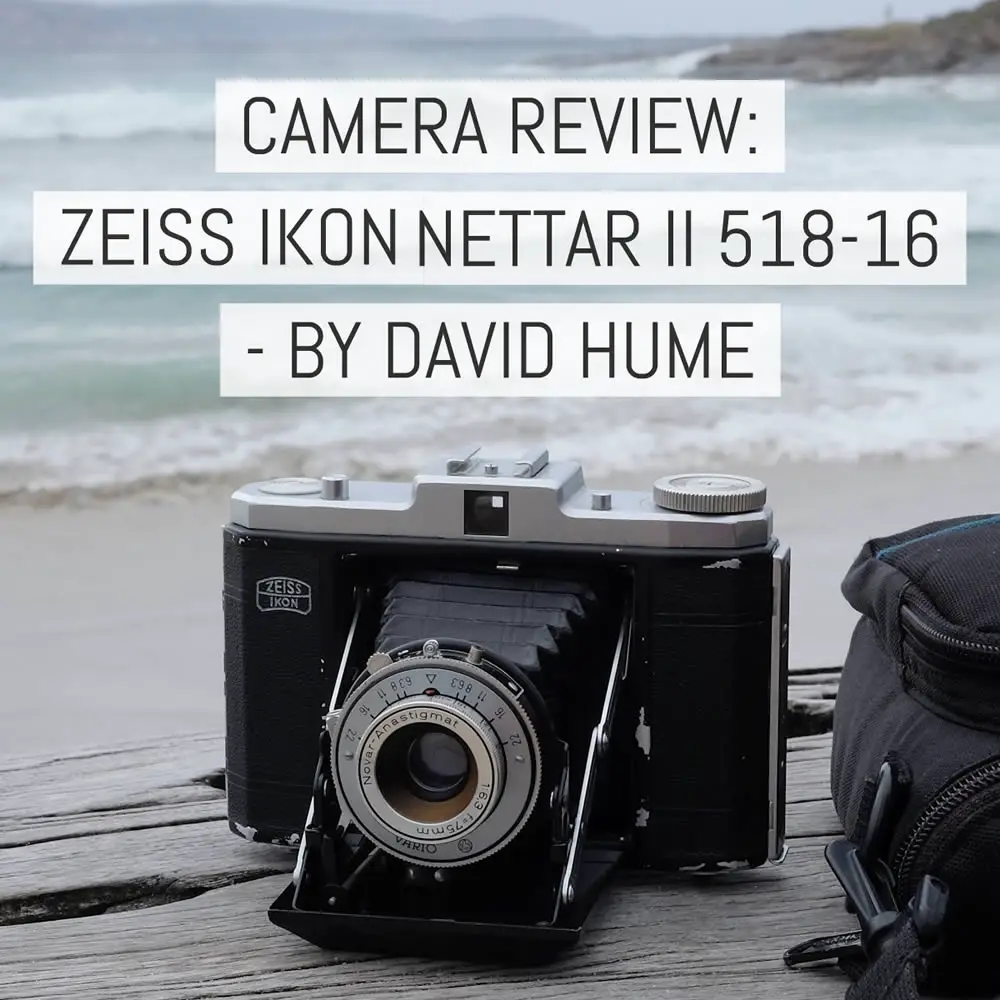
I bought my Zeiss Ikon Nettar 6×6 folder in 1992 for $50, pretty much in perfect nick. At the time I was shooting a Mamiya RB67 professionally; exclusively running Fuji Velvia through it for magazine covers and editorial work. For stories that didn’t pay enough to justify medium format I used 35mm Velvia or Sensia in a Nikon FM2, for which I owned precisely three prime lenses. I had a medium format enlarger that I used with black and white film for fun, so I thought the Nettar would make a nice travel camera.

I only shot a couple of rolls with it back then. The lens did not impress me much with its sharpness. This was back before digital of course, so there was no “film look” – everything was film back then.
Anyway, the camera sat in a cupboard for 25 years. I pulled it out every now and again, but the shutter had stuck, so I would just admire it and put it back.

In 2017, I started shooting a bit of 35mm film again for one of my art projects. I wanted square format, so I was using an Agfa Rapid that shot 24x24mm on 135 film. 35mm was not doing it for me though, I did not feel an empathy with it. It was too small and fiddly to handle; not organic enough.
I pulled the Nettar II out again. Lo and behold, the shutter was working perfectly! I took this as a sign and bought myself a pro pack of Kodak Portra 400.
So let’s have a bit of a closer look at this camera. Zeiss Ikon, of course, needs no introduction. They made a lot of folding cameras – and the Nettars were the cheap ones, but shared bodies with the more expensive Ikontas. This camera is very basic, even for the early 1950s when it was made.
It’s a viewfinder only zone focus camera – no rangefinder. The lens is a Novar Anastigmat 75mm f/6.3, which I think is a triplet. Let’s just say that it is not too bad stopped down, and has a lovely softness wide open.
This is the thing though – In 2018 you’re not shooting this camera for ultimate resolution.
Here’s how it works:
You open the back, wind the film on, close it, wind on until you see the little number “1” in the ruby glass window at back, and away you go.


Shutter speeds, aperture and focus all happen up the front around the lens. There are three marked speeds; 1/25, 1/75 and 1/200s. Apertures are smooth from f/6.3 to f/22. When you’re ready to take a shot you cock the shutter, frame the shot, and press the silver button on top.

There’s a reassuring little buzz as the cocking lever flips back and you wind on so you won’t double expose. There are no stops or interlocks, you’re on your own regarding when and how far you wind the film.
Here’s the gotcha: I’m shooting Kodak Portra and the numbers on the film backing are a kind of purple (I think) that is almost impossible to see through the ruby glass of the window. It is really easy to miss the numbers, and if you’re shooting at dawn or dusk it pays to take some kind of flashlight with you. Or use your iPhone light, which I would have anyway as I’m using a light-meter app to get the exposure.
So what’s it like and why do I like it? It is damned simple and it works.
It is small; It’s about the same size as my APS-C mirrorless bodies and way smaller than a 35mm SLR. It is tough. When it’s folded up there is nothing exposed to the elements and it slips into a small pouch I found in a cupboard at home. There are no batteries or electronics to bug you.

What’s it good for? Landscapes. Landscapes when you are out hiking or travelling. I’m writing this from my hotel room in Southern Western Australia where I’ve just done a nine-day bike tour taking the Nettar. I’ve just posted a roll back home for my daughter to have processed for me.

I’m shooting it because I really like the results I get from it. I have a thing about the square format at the moment. I’m a visual artist and all my paintings are square. I figured for my personal photo work I would stick to square as well. I like the shop scans I get from it, but I really like to show the edges of the frame, so that mean scanning the film myself, which I do with a light box and DSLR.
Here’s another thing: for me, it works with modern film in a way that it never would have back in the 1950s. Let me explain. I like to shoot at dawn or when it’s dingy and overcast to get the mood I’m after. In the 1950s you’d be shooting 50 ASA – maybe 100 tops, and with the minimum shutter speed of 1/25s you won’t have enough light at f/6.3. On the other side of that, when it’s daylight but dingy I can just get away with 1/200s and f/22 without overexposing. On a bright day, I’m overexposed, but those are not the conditions I favour. So I can use it in 2018 in a way I never could have back in the day.

That’s about it.
What’s it not good for? Anything except moody landscapes I’d say. Of course, with no rangefinder and no idea how accurate the distance scale on the lens is, it’s not a go-to camera for portraits! Having said that, I did shoot a couple of my daughter to finish a roll, and yeah, I got one I liked.


Best you have a look at what I’ve been doing with it and make your own mind. The cost of admission is very low if you want to pick one up and take it for a spin.
~ David
Share your knowledge, story or project
The transfer of knowledge across the film photography community is the heart of EMULSIVE. You can add your support by contributing your thoughts, work, experiences and ideas to inspire the hundreds of thousands of people who read these pages each month. Check out the submission guide here.
If you like what you’re reading you can also help this passion project by heading over to the EMULSIVE Patreon page and contributing as little as a dollar a month. There’s also print and apparel over at Society 6, currently showcasing over two dozen t-shirt designs and over a dozen unique photographs available for purchase.


13 responses to “Camera review – the Zeiss Ikon Nettar II 517/16 6×6 folding camera”
I have my father’s which he bought before I was born in 1954. It was the first camera I learnt how to take photos on. Looking back the market it was aimed at was full of basic cameras like the Nettar. In the fifties outside of the USA, it was what could be afforded. In the late sixties camera and junk shops were full of cheap 6×6 bellows cameras, most of which were a lot worse quailty wise than the Nettar.
Amazing, but there are still photographers out there using Zeiss Nettar in 2024.
I’m one of those…
Bought mine in 2006 for $70, in a small camera shop (one that also sold peony potted plants to Chinese gardeners!) in Melbourne. Got it with a case, a hood, and an original Zeiss slip-on YG filter, all for that price. The last of the truly good bargains, I reckon.
Mine has the Novar 75/4.5 lens and (this is apparently a rarity) a Synchro-Compur shutter with speeds in the full range of 1 second-1/300. So it would date to the early 1950s.
I use it sporadically. My hoard of 120 roll film, once numbering in the hundreds of rolls all safely tucked away my film/paper fridge, is now down to about two dozen and a few more. When they are gone – well, what will I do?These days in Australia buying a five-pack of 120 anything is more an investment than a purchase. And let’s not go into processing costs, which could easily lead to wrist-slashing in the back yard. This after all is Australia, the land of ultra high cost for everything. Our glorious leaders would charge us through the ears for air to breathe if they could, let alone what we have to pay for film and other photo basics with our devalued South Pacific Peso. But enough said about all that, my comment is about the Zeiss Nettar and not Aussie third world economics.
So yeh, I take it out now and then. It shares time out with a Voigtlander Perkeo I which was given to me by an elderly friend who was downsizing. The Perk also has a Synchro-Compur with speeds up to 1/500, and a wonderful Color Skopar lens which renders mid-tones unlike any other gear I’ve used, film or digital.
Those 1950s German rangefinder cameras were truly marvelous machines. Basic as anything but thoroughly reliable, and with a little care and some mindful concentration you get results almost as good as those I’m used to with my 1962 Rolleiflex TLR with a 75/3.5 Planar.
The Nettar (or for that matter the Perkeo) will never ever replace my Rolleifle which I’ve owned since 1966 and fully intend to take with me when I trot off to the big Disneyland in the clouds. But it’s a reliable and good worker and I would strongly urge anyone who finds one for sale at an affordable price to cough up the cash and buy it, especially if it’s less than $100 and it has a good Novar lens and a shutter with full speeds. But do check the bellows and click the shutter a few times to make sure it’s working… or you’ll have a shelf queen on your hands.
Best, DANN In Melbourne (currently in Indonesia)
Thanks for the review David.
I love mine, shooting BW portraits in the studio. Set-up the studio lights, take a preview (test shot) on DSLR. Then hook the sync cord to the socket on lens and fire away.
With F8 and 1/125 or 1/200, Ilford FP-4 or Fuji Portra both work really well.
I picked one up last year for £30 and having shot 2 rolls of Tri-X decided it was worth a CLA. With everything working as it should (and a third party rangefinder stuck in the accessory shoe) it is great for more than just landscapes (which is admittedly what I bought it for).
The size, as mentioned above, is ideal. When folded it fits in a jacket pocket. I have always struggled with medium format as I could never really enjoy the size and ergonomics of Hasselblad/Mamiya/Rollei cameras. That said, I have started a savings fund for a Mamiya 6 rangefinder).
They are cheap and simple and give great characterful results.
? https://t.co/WIxPnp0KM7
I just bought a 517/16 and a 518/16, but I also got a little snap-on lens from the same period for doing portraits with them.
The lens comes in a little box and includes a conversion chart for how to focus the camera with the lens attached.
I can’t wait to try my hand at some portraits this way. It’s like stepping into a time machine. Even the smell of the camera back is from a time long ago 🙂
My sister gave me a Nettar 517 as a present, so I even skipped its admission cost! I’ve had some trouble coming to grips with its bare-bones operation though, frugal even for the ’50s: no double-exposure lock, no rangefinder, only three shutter speeds plus B and all the more feet instead of metres on its focus ring (I live in Europe). Yet after some catfight with it (double, triple exposures, out-of-focus takes, parallax errors) I’ve eventually come to the same conclusion as the author: Nettars best suit landscapes, where you can check every setting twice before shooting—and where it gifts you with a lovely vintage touch you can feel Ansel Adams for one second with.
Wonderfull shots…its not about the camera but mainly about the eye of the photographer, the one in thei dusk light are amazing.Insiration for me.
I picked up a Nettar a few weeks ago and I’m really enjoying it. Takes a bit more thought than a Holg… https://t.co/esWd6y0JOE
I had one of these, then swapped it for a Perkeo ii. Lovely little things.
Great little review and solid images. Makes me want to go hunt one of these cameras down. Thanks for that!
I’ve been using an Ensign Selfix 16-20 6×4.5 recently – very similar design to your Zeiss and an excellent pocketable camera 🙂
I’ve wondered about the Nettar for a long time. I’ve got an Agfa Isolette I liked to use, but the foc… https://t.co/ZG2WapKJog