
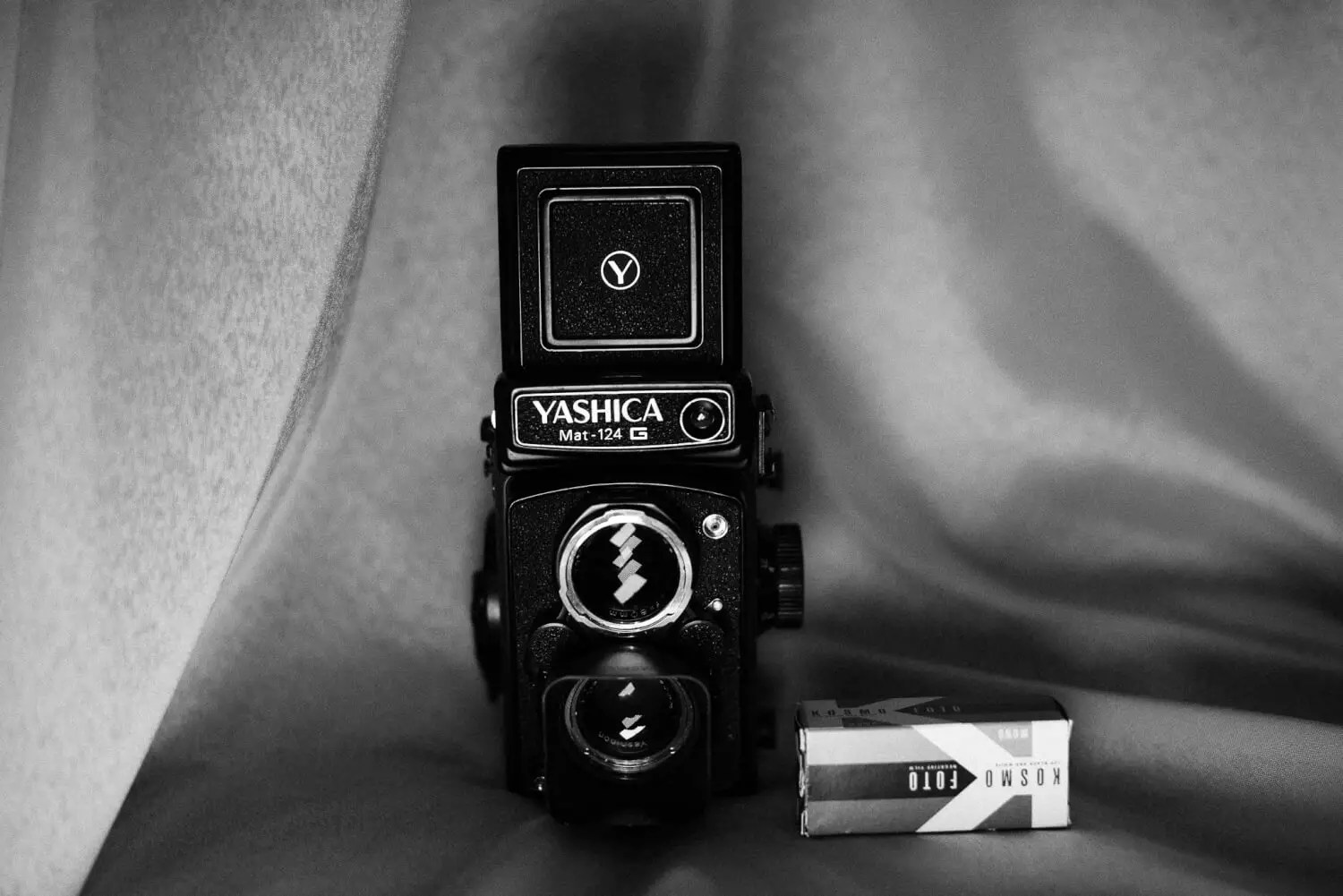
The Yashica Mat 124G, an embodiment of mid-20th-century camera engineering, greeted me with its robust, yet elegant, presence. The utilitarian design, devoid of modern frills, conveyed a sense of purpose. This camera deserves to be out there, not on the shelf for some decorative purpose.

A few months ago I won this camera on eBay bidding for really good price. I never had a chance to hold or shoot a TLR camera but always wanted to try one. Why Yashica Mat 124G? It’s a beautiful camera and functional. Big, plus you can buy one for fraction of price of some other brands.
When the camera arrived I just took quick look and set it aside until few days ago. My surprise was when I discovered name tag in leather case — this tells me that this camera was owned by someone who really cared for it. I had A spare roll of Kosmo Foto Mono 100 film and day off.


Film Loading was simple with that clunky sound. The frame counter hit 1 — which I wasted. I forgot to lock the shutter and the first photo was taken by my photo bag.
Location which I visit is actually near my home in Cape Planka. It’s natural barrier between the North and South Dalmatian coast. We call it Zlatni Rat, the Croatian Gold Horn or Cape Horn beacuse of the strong winds and distinct look. St. John’s church is located there, there are also some local legends about particular place. Check it out on Google Maps.
The viewfinder was tricky to master beacuse everything was inverted, but I really enjoyed to compose square format this way, especially without “state of the art autofocus and other electronics”. Don’t get me wrong, as profesional photographer, shooting with state of the art cameras for commercial work is a must. But this was really liberating process — instead I just composed, shoot, rewind & repeat.


Film exposing — I just used smartphone app, read light from open shadow and that was it. The day was slightly overcast and there was no room for big mistakes. Most of the photos are taken at 1/125 sec between F/8 – 11. The film was rated at EI 100.
I developed film in Atomal 49 developer for 8min at 20 C and let it dry for few hours. It turned out pretty well! Not bad form my first TLR expirience.


Conclusion: A simple and straightforward camera, nothing here is unnecessary, every button or dial has purpose. Focusing works beautifully. Creating process with this camera is relaxing beacuse this camera it doesn’t get in your way — sure yes, inverted image in viewfinder is bit tricky to master but hey — this was my first film roll and I know it’s not the last one! Paired with my Nikon F3 I have some really good tools for creating photos.
Thank you for reading.
~ Antonio
Share your knowledge, story or project
The transfer of knowledge across the film photography community is the heart of EMULSIVE. You can add your support by contributing your thoughts, work, experiences and ideas to inspire the hundreds of thousands of people who read these pages each month. Check out the submission guide here.
If you like what you’re reading you can also help this passion project by heading over to the EMULSIVE Patreon page and contributing as little as a dollar a month. There’s also print and apparel over at Society 6, currently showcasing over two dozen t-shirt designs and over a dozen unique photographs available for purchase.


8 responses to “My First Roll… With a Yashica Mat 124G”
The 124G is a good – even a great – camera. In the right hands.
For the photographer who can make the best use of this, or any other camera, the Yashica TLR is a masterful tool.
Not that I claim in any way to be one of the above. But I cut my teeth in the photo world in the 1960s, first with a Yashica D, then an A, a 235, eventually a 124G, which served me well ’til I saved up enough to buy my first Rolleiflex TLR, a secondhand 3.5E2, in the late ’80s.
I did tens of thousands of (mostly B&W) images with my Yashicas, most with the 124G. It uses Rollei bayonet I accessories made for the amateur market and less expensive than those for the larger Rolleis, but Yashica also made a range of very good quality extra bits for their cameras, all well worth acquiring when they turn up on the secondhand market.
I now use many film (and yes, also digital) formats. For me a major ‘plus’ with Yashica TLRs was how few accessories I needed to make good images. A lens hood, a UV, one or two B&W filters, and a meter – I had (and still have) a beaut Weston Euromaster, amazingly after 51 years it goes on working – and a few rolls of 120, all these small bits easily fit into a pocket so you don’t have to lug a humongous camera bag when you go out to photograph the big beautiful world ready and waiting to pose for you.
No need to mention the ease of printing or scanning those 6×6 cm negatives. Color slides shine with beautiful tones, sadly slide film is now too expensive for most of us to buy and the processing often costing as much as the film did. Every 124G owes it to themselves (and the camera) to use at least one roll of Kodak or Fuji positive film, the experience of viewing those images will be worth it…!
After sitting in my camera cabinet for about a decade, the ‘Mat came with me to Australia when I relocated there in the early ’80s.I used it now and then and finally donated it to a camera club in regional VIC, where it was still in occasional use about ten years ago when I last visited that group.
Sadly, in AUS, land of everything to do with analogue photography now ridiculously expensive, cameras like this little beauty mostly sit idle due to the high cost of 120 roll film. A sad waste indeed of such fine cameras, but that’s life in Century 21.
An excellent article by a talented writer-photographer, kudos to you.
Best from DANN, ex Melbourne, now in wonderful retirement in Indonesia.
interesting attempts, and decent results! unusual composition in parts, dry and bare landscape atmosphere captured well on a very basic film; I think Yashica is one of the more compact and easier to work with TLR cameras, have you tried Ilford SFX or Pan F or Foma Retropan? I would use this TLR regularly if I could get my hands on a decent fully functional one including the light meter which if in good order does a very good job. available at a fraction of a price of some Mamiyas or Rolleiflex. all the best!
Your blog is like a beacon of light in the vast expanse of the internet. Your thoughtful analysis and insightful commentary never fail to leave a lasting impression, particularly your discussions on mmo. Thank you for all that you do.
My Dad had a Yashica for 70 years. I lost track of it when my brother took over his care. Just curious if the name inside was Bradley L. Jacobs. I don’t want the camera, I’m just hoping it found a good home and you sound like an excellent choice! My Dad lived to be 92 and took thousands of images.
What are you using for a battery?
Upon buying Yashica I found old mercury battery in battery compartmant, Contacts were coroded. I tried replacement battery but without luck. Corrosion probably destroyed electronics. For lightmetering I used smartphone app
My first experience with photography in high school was with a Yashica D. Without the metering and fast film crank of the 124G but same glass (Yashinon). I enjoyed that so much that later, when I was in college (or university), I managed to find one that I could afford. I still have that camera, and I find that it holds up well against a much more expensive and capable Rollei 6008 Professional. You have a great tool there. Hope you enjoy it for many years to come.
Nice photos! Good luck with your new photographic tool.